

This is a guest blog from Patrick Turner, IT Systems Trainer at Leeds Trinity University, a Fellow of the Higher Education Academy and a member of the community-led skills development project group.
In today’s higher education landscape, digital capability has moved far beyond being a ‘nice to have’. It now underpins all aspects of the university proposition: teaching, research, student support, and operations. Yet staff digital skills development is still too often overlooked or left to individuals working in isolation without the guidance, resources, or sector insight they need. Creating digital skills communities can shift this dynamic, providing structure, shared learning, and a supportive environment where colleagues can build confidence, exchange ideas, and navigate an ever-evolving digital landscape together.
Internal Digital Skills Community
At Leeds Trinity University, developing an all-staff digital skills programme required addressing the significant variation in digital confidence across the institution. For many colleagues, the thought of completing the programme felt daunting, so establishing a space where staff could learn from and support one another was essential.
A dedicated Microsoft Teams digital skills community provided that space. An inclusive, low-barrier environment where colleagues could connect, share practical tips, and offer real-world solutions that don’t always surface through formal training. This internal community made it easier to build trust, encourage honest discussion, and cultivate shared purpose. It has been especially beneficial for new starters, helping them feel part of a collective development journey rather than tackling digital capability alone.
Cross-Institutional Digital Skills Community
While institution-level communities are vital, cross-institutional networks offer broader perspectives and deeper expertise. Connecting with colleagues who lead digital transformation or deliver digital capability initiatives across the sector accelerates problem solving, strengthens practice, and reduces duplication. Larger sector wide communities bring together voices from instructional design, digital accessibility, AI literacy, pedagogy, and change management; enabling richer discussions and quicker idea exchange.
However, large networks can also feel less personal, particularly for those with lower digital confidence. Discussions may be dominated by a small number of contributors, while others engage more quietly. For this reason, I’ve found that being part of both large and smaller community models works best. I participate in broad, sector wide groups, such as the HE Digital Practice and Innovation Network, while also maintaining smaller, more focused cross-institutional communities with colleagues in institutions similar in scale to Leeds Trinity University. These smaller networks have enabled targeted peer support, collaborative problem solving around shared resourcing challenges, and more meaningful benchmarking of digital capability and project outcomes.
Together, small and large communities create a powerful ecosystem: intimate enough to foster trust and personalised support, yet expansive enough to draw on the collective intelligence of the sector.
Key benefits of cross-institutional digital skills communities
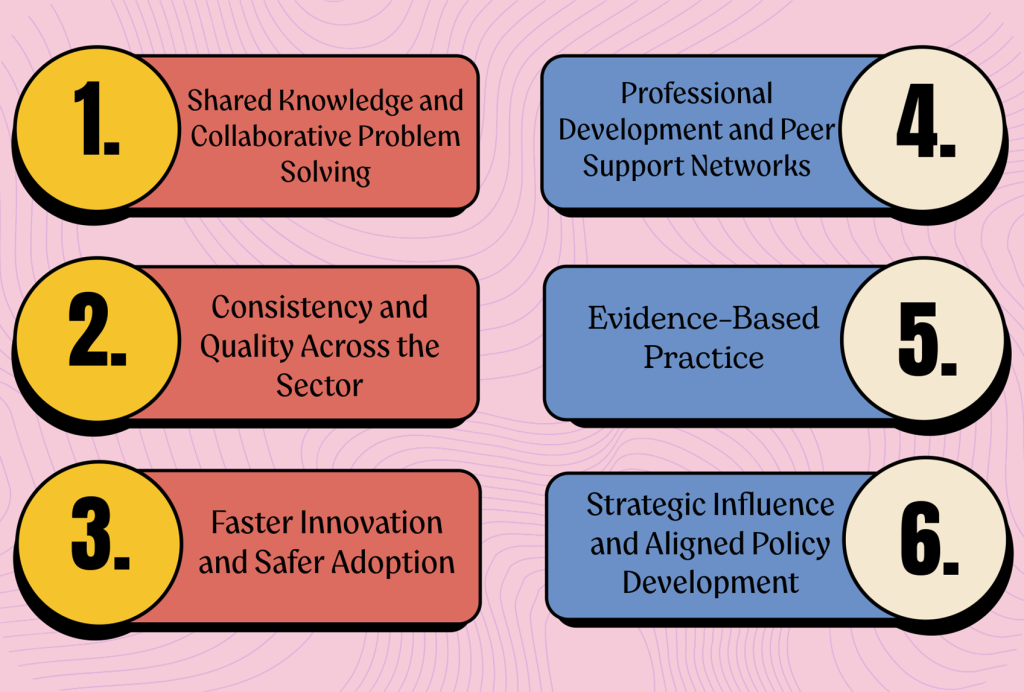
The key benefits of cross-institutional digital skills communities are:
- Shared knowledge and collaborative problem solving.
- Consistency and quality across the sector.
- Faster innovation and safer adoption.
- Professional development and peer support networks.
- Evidence-based practice.
- Strategic influence and aligned policy development.
Developing your digital skills community
Digital skills communities; whether internal, cross-institutional, small, or large, play a crucial role in building confidence, reducing digital inequality, and fostering a culture of shared learning. They help universities evolve into more agile, collaborative, and digitally mature institutions that are better equipped to innovate and meet emerging challenges.
If you’re looking to strengthen digital capability in your institution, Jisc’s new co-created guide on Activating community-led digital skills offers practical approaches, tested methodologies, and sector informed advice to get started.
What’s your story?
For our next release of the guide, we’d love to hear your stories about the impact of digital capabilities/skills communities.
We welcome stories from a range of different perspectives. Please get in touch by completing our stories form.
We’re interested in hearing from you if you are:
- a member of an in-house staff community for building digital capabilities/skills
- a community-lead for in-house community at your college or university that helps build staff digital capabilities/skills
a member of any wider community that helps you build digital skills and practice - someone involved in facilitating a community for cross-sector/multiple organisations, on any topic related to digital in education
- Your story could feature in our resources. Your contribution can be anonymous or you can share your details with us.
You can also connect directly with peers by exploring Jisc’s Get Involved page, where you’ll find a range of active communities and networks focused on digital capability, practice, and innovation.
Featured image from Vlad Hilitanu on Unsplash